
The Only Exit
A 15-Hour Workweek Could Destroy Global Capitalism, So Why Is No One Fighting for It?

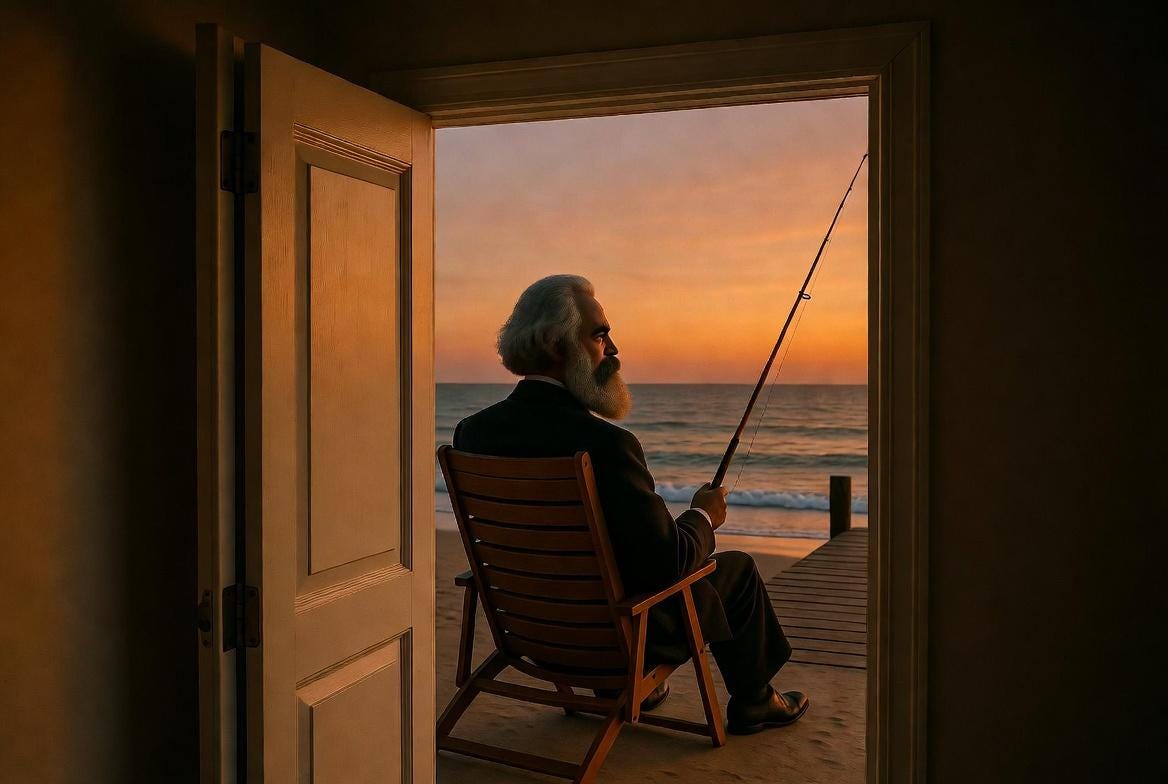
The working class has one real hope: putting an end to the production of value, and thus to itself as a class. That’s not a slogan. It’s a logical deduction from Marx’s critique of political economy.
The practical form of that hope is a radical reduction of the workweek. Not to 35 hours. Not to 32. To 15 hours — with no loss in weekly pay. That is the point at which the worker advances so little unpaid labor time to capital that the entire value relation begins to dissolve.
Free time, not labor time, becomes the measure of wealth.
This is not a utopian fantasy. It is a material possibility. Global productive forces are sufficiently developed that 15 hours of socially organized labor, intelligently deployed, could meet all human needs. The only thing standing in the way is the value form — and the state that enforces it.
So here is the question that should haunt every socialist: If the 15-hour week is possible, materially and logically, why has no working class in any advanced capitalist country ever made a serious, sustained, mass demand for it?
Not in the 1930s.
Not in the 1960s.
Not after the 2008 crash.
Not after COVID.
Not in the US, Germany, Japan, France, or Britain.
Not once in ninety years.
The silence is not accidental.
It is the central, unacknowledged scandal of revolutionary Marxism.
The Logic Is Sound
Let’s be clear about what a 15-hour week would actually do.
First, it would invert the credit relation that hides exploitation. Under capitalism, the worker advances labor power to the capitalist — working for a week before being paid. That advance is interest-free credit extended by the worker to capital. At 15 hours, that advance shrinks to the point where the capitalist becomes dependent on the worker’s cooperation, not the other way around.
Second, it would force automation to its logical conclusion. Marx showed in Capital, Vol. 3, Chapter 9 that a capital using no living labor (v=0) can still receive profit — but only as a transfer from other capitals that do employ workers. A single country reducing the workweek to 15 hours would not collapse. It would trigger capital flight, yes — but capital flight is a feature, not a bug. Capital moves to where it is needed. And where it lands, workers will eventually make the same demand.
Third, it would break the dollar’s global hegemony. The United States is not just a national capitalist state. It is the enforcer of global value relations through the dollar as world money. A US working class that won 15 hours would destroy the domestic basis of that hegemony. The resulting crisis would force every export-dependent country to reduce its own workweek or face catastrophic unemployment.
The logic is ironclad. The 15-hour week is the detonator that could bring down global capitalism.
So why is nobody reaching for it?
The Structural Alibis
The standard Marxist answers are not wrong. They are just incomplete.
Yes, the state has become the national capitalist — the permanent manager of a dying system. It suppresses wages, expands credit, and enforces long hours. It would crush any serious movement for a 15-hour week with every weapon at its disposal: repression, co-optation, division, and war.
Yes, the labor aristocracy exists. US workers, in particular, have been bought off — not with high wages (which have stagnated for fifty years), but with cheap goods produced by super-exploited labor abroad, credit that substitutes for income, and the psychic wage of whiteness and empire.
Yes, the working class is fragmented — split by skill, race, gender, geography, and the constant threat of precarity.
These are real obstacles. But they are not absolute obstacles. The working class has overcome worse. The question is not whether the obstacles are large. It is why they have not been seriously challenged for ninety years.
The Missing Variable: Defeat
Here is the answer that no structural Marxism wants to admit: The working class has not made this demand because it has been defeated — not just in strikes and revolutions, but in its capacity to imagine.
The defeats of the twentieth century were cumulative and devastating.
1917–1923: Revolutions across Europe are crushed. The dream of workers’ councils fades.
1933: The German working class, the most organized in the world, fails to stop Hitler.
1936–1939: The Spanish revolution is drowned in blood.
1945–1948: The postwar settlement stabilizes capitalism, offering consumption instead of emancipation.
1956: Hungary. 1968: Czechoslovakia. The Soviet Union, already a deformed workers’ state, becomes a cautionary tale against any shortcut.
1973: Chile. The last democratic road to socialism is bombed into the past.
1980s: Neoliberalism. Unions are broken, wages are flattened, and the gig economy is born.
Each defeat narrowed the horizon of possibility. What was thinkable in 1919 — the six-hour day, workers’ control, the abolition of wage labor — became unthinkable by 1999. The demand for fifteen hours today sounds insane. Not because it is economically impossible, but because the working class has internalized its own impotence.
The door could have been opened at any point in the last ninety years. But the working class no longer believes it is a door.
The Ideological Lock
The state’s greatest achievement is not welfare or war. It is the naturalization of the forty hour workweek.
Forty hours feels like a fact of nature. It is not. It is a political outcome — one that capital fought fiercely to establish (against the ten-hour day, the eight-hour day, the weekend) and has since frozen in place.
Every time you hear a worker say, “I could never work less — I’d lose my house, my health insurance, my identity” — you are hearing the echo of ninety years of defeat. The state and capital have successfully tethered survival to full-time wage labor. Credit, debt, mortgages, student loans, health care, childcare — all presume a 40-hour week. To demand 15 hours is to demand the unthinkable: the complete reorganization of social reproduction.
The left has done little to challenge this. Instead, it fights for incremental reforms: paid leave, sick days, a $15 minimum wage. All good. All necessary. But none of them challenge the workweek itself.
And here is the cruel irony: Those incremental reforms are often harder to win than a radical reduction of hours would be — because they are fought entirely within capital’s logic. A 15-hour week breaks the logic. It is a different kind of fight. But you cannot win it unless you fight it.
What Would It Take?
I don’t know. And that is the honest answer.
I cannot tell you when or how the working class will wake up from its ninety-year sleep. I cannot tell you what crisis — ecological collapse, mass automation, a pandemic, a fiscal crash — will make 15 hours seem not utopian but necessary. I cannot tell you how to overcome the fragmentation, the fear, the internalized defeat.
But I can tell you this: The only socialist demand that actually threatens capitalism is the demand that workers work less — much less — for the same pay. Not because it is more radical as a slogan, but because it attacks the value form at its root: the equation of labor time with social wealth.
Every other demand — higher wages, better benefits, stronger unions — can be absorbed by capital. It will raise prices, automate, offshore, or inflate its way out. But a 15-hour week with no pay cut cannot be absorbed. It is a limit that capital cannot transcend. It is the point at which the working class stops being a seller of labor power and starts becoming a human being with time.
The Puzzle Remains
So here we are. The logic is sound. The material conditions are ready. The door has been waiting for ninety years.
And the working class, in every advanced capitalist country, has walked past it again and again — not because it is stupid, not because it is bribed, not because it is fooled, but because it has been broken.
The task of communists is not to pretend we have an answer to this puzzle. The task is to stop pretending that the puzzle does not exist.
We cannot will the working class to make a demand it does not feel. But we can stop offering demands that leave the value form intact. We can build organizations that are accountable to working-class communities, not to the state. We can analyze the mechanisms — credit, debt, housing, healthcare — that tether workers to 40 hours. We can name the defeat, instead of ignoring it.
And maybe, in a crisis that no one can predict, a few workers here and there will begin to ask the forbidden question: Why am I still working forty hours when the machines could do it in fifteen?
If enough of them ask it, the door might finally open.
And on the other side is not socialism as a slogan. It is free time — the only wealth that matters.
This article draws on discussions of Marx’s value theory, the temporal logic of the wage, the global dollar hegemony, and the terminal phase of capitalism. It offers no guarantees. Only a door.